Eligibility forMedicaidto help pay nursing home bills requires individuals to meet the guidelines for the program they are applying. Basically, there are three such guidelines; proof of medical necessity for long-term care, limited assets, and insufficient income. If the assets or income exceed the allowed amounts, the individual may not initially qualify, but there are ways to work with the determined spend down. This is the common phrase used in the qualification process.
It is important to have a comprehensive understanding of Medicaid rules and how to maximize the concept of “spend down,” before applying. For those applicants not initially qualifying financially, a qualification plan is essential. This guide will provide a simplified analysis of what a spend down in the state of Missouri entails, how it works, and how to work within the underlying rules.
*This blog is for educational purposes only and should not be considered legal advice. The use of the Paths Law Firm website does not constitute a client-lawyer relationship.
What is a Spend Down?
One must first accurately understand the spend down concept. Very basically, it means what has to be properly spent to reach the monetary limitations for Medicaid. When actually planning, spend down refers to a financial strategy to help qualify for Medicaiddespite not initially qualifying due to excess assets or income.
There are federal and state statutes, regulations, and rules related to the application process. There are cases that also impact this process. In order to utilize a spend down in the application process, the end result proves the applicant’s income and assets are insufficient to provide proper care.
There are federal laws that apply to each state, but states also have their own. The states cannot be more liberal than federal law but can be more restrictive. There are many variations among the states in the laws and the interpretation and application of them when it comes to spend down eligibility. Even states next to each other may vary widely, for example in Kansas a community spouse’s retirement accounts are not included when determining a married person’s eligibility, but in Missouri, such are included in the determination. There are many other differences, as well.
It is important to work within the laws and rules for the state in which the nursing home is located before proceeding.

How Does a Spend Down Work?
In Missouri, the institutionalized spouse or the unmarried individual must simply provide evidence their monthly income is lower than the cost of the medical care.
Rules of a Spend Down
The rules in Missouri for a spend downrevolve around a set limit of $5,000 for countable assets or resources for the person requesting Medicaid. Very basically if the applicant’s assets exceed $5,000, they are considered “over-resourced” and therefore not qualified. But it is important to know the law in order to utilize it.
1. Married Couples Both Applying
With married couples, it is possible to move forward with a resource limit of $10,000 for the combined countable assets. Individual applicants do not get to combine their assets with anyone else in their family even if they are residing in the same household. It is also important to note, there are variations as to what is permitted and what is not depending on the Medicaid program for which the couple is applying. However, for the regular Medicaid program, the set limit is $5,000 per individual, thus allowing for a married couple to have $10,000.
2. Married Couples with One Applicant
Another variation, and more common, is when one spouse is applying for Medicaid. This person is referred to as the institutionalized spouse. The spouse not applying for Medicaid, and not in a nursing home is referred to as the Community Spouse. In this scenario in Missouri, all assets owned by both or either spouse are combined and counted.ÂThis is true even though only one person is applying. If the application is for the nursing home Medicaid program, the institutionalized spouse is allowed to no more than $5,000 in total value of countable assets.
The community spouse is allowed to keep one-half of the couple’s assets, with certain limitations and considerations. The half referenced can be at least a minimum, but not to exceed a maximum. The amount the Community Spouse is allowed is referred to as the Community Spouse Resource Allowance or often abbreviated CSRA. The minimum CSRA is currently $25,728. The current maximum is $128,640.
Example One: If the couple’s combined countable assets total $100,000. The CSRA is $50,000. In this example, the Institutionalized Spouse is considered to have $50,000 but is only allowed $5,000. Thus, the spend-down is $45,000.
Example Two: If the couple’s combined countable assets total $40,000, the minimum CSRA of $25,728 is attributed to the Community Spouse. After deducting the Institutionalized Spouse’s $5,000 from the remainder, the spend down is $9,272.
Example Three: If the couples combined countable assets total $350,000, this doesn’t change the maximum CSRA, so the Community Spouse is attributed $128,640, with the remainder attributed to the Institutionalized Spouse. This would require a spend down of $216,360. This emphasizes the importance of understanding the laws as proper use will likely result in preserving the $216,360 and not actually spending it.

Spend Down Exemptions
When it comes to qualifying for Medicaid, there has to be a detailed assessment of the individual’s asset or income spend down. This means the individual has to show they have spent a certain amount of their income and/or assets based on medical fees or relevant expenses. However, evidence of other debt such as mortgage payments or credit card payments will affect the financial situation.
As for healthcare costs, there are exemptions built into the process such as:
* Medical Fees (Past or Present)
* Transportation Costs for Medical Services
* Prescriptions/Medical Equipment
* Home Improvement Costs for Medical Reasons (i.e., Chairlift)
These are key details to think about when it comes to understanding what the exemptions are when applying and what to account for.
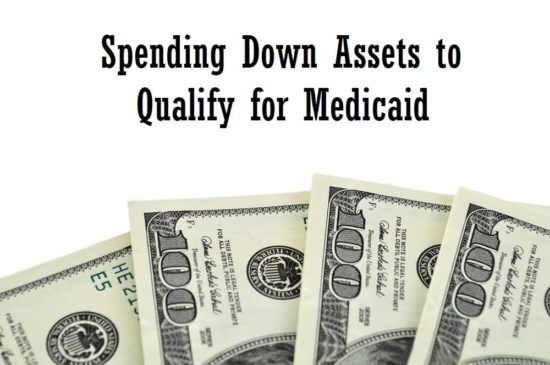
The spend down amountis the difference between an individual or couple’s income and the limit set forth for Medicaid eligibility. This is determined by each state over one to six months. Depending on the state, bills or receipts will likely be required by the Medicaid caseworker to evidence the expenses. This is not usually an issue when applying for nursing home Medicaid as few individuals or couples have sufficient income to pay for the nursing home without accessing their assets.
1. Income Spend Down
The idea of an income spend down is to look at the expenses a person is paying for based on their underlying income. For example, let’s assume a person brings in $1,000 per month, while the income limit is set at $500 per month. In this case, it is essential to show there is a $500 spend down before applying for Medicaid to be permitted to move forward with the application. This can be done by showing a certain portion of the income was spent on the person’s medical expenses such as prescriptions, home improvement changes, and/or other relevant costs. Again, this is not usually an issue when nursing home expenses are being incurred.
2. Asset Spend Down
It can be quite difficult to determine if an individual is over the asset limit with all of the exempt and non-exempt assets as defined by Medicaidalong with the extensive rules to which an application must adhere. Medicaid has set asset limits, depending on the state in which the applicant resides. It is important to note this does not include assets such as the primary home and/or vehicle. A primary home and or vehicle are considered to be exempt assets and are not factored into the equation. This does not mean those assets are not subject to estate recovery after the applicant dies. It also does not mean the applicant will be allowed enough income to maintain those assets, such as for insurance, taxes, or utilities. It simply means they are not counted with the other assets when determining qualification.
It may not affect too many applicants, but the home’s equity is limited to $595,000. Also, individuals are not required to count personal belongings such as clothes and/or other relevant items in use.
It is important to understand what a countable asset is to ensure assets are properly accounted for. A countable asset can be something as simple as money in a savings account, a second property generating rental income, or other various investments. See more onMedicaid Asset Limits here.

How to Calculate a Spend Down
The Medicaid spend down program or Medical Assistance, is for medical needs and not necessarily referring to the nursing home. The nursing home program is referred to as Vendor Benefits. Medical Assistance is also referred to as Medicaid’s medically needy program. The spend down amount can be calculatedby taking the difference between the Medicaid eligibility limit and the applicant’s income, based on the state in which the applicant resides. Depending on the state, there may be an option to pay a monthly premium to Medicaid for the amount over the Medicaid spend down amount.
In general, it is recommended to speak to anexperienced Missouri Medicaid Lawyerto learn more about the available options and to ensure all established guidelines are being met.

Spending Down Assets to Become Eligible
Qualifying for the Medicaid program is determined by demonstrating the eligible applicant meets all the requirements defined for the program to which making the application. If the individual’s income exceeds the Medicaid income limits for Medical Assistance, it will be necessary to spend down income and maybe assets. The Medical Assistance programs require personally spending a certain amount of income and/or assets on eligible medical costs, usually monthly. The Vendor Benefits program usually requires all income paid to the nursing home, less any health care premiums, and a $50 personal needs allowance.
Even though the above may seem daunting, there are also ways to preserve income through the anti-spousal impoverishment rules or certain income trusts. An attorney experienced practicing with Medicaid can assist with the most asset and income preservation, qualification, and the application for the appropriate Medicaid program.
Medicaid re-qualificationin the state of Missouri will be required within each anniversary year from the first application. However, due to the COVID response, Medicaid is currently only required every two years. Re-qualifying means income and assets must be re-evaluated to ensure applicants still qualify and if necessary, come up with a relevant spend down to move forward with the coverage. There are set spend down periods that must be taken into consideration with regulations to be adhered to each time to re-qualify.

Eligible Expenses
The eligible expensesto qualify are the most important part of the spend down process when verifying eligibility for Medicaid. In general, an over-resourced Medicaid may spend, as long as fair value is received in return and transfers, such as gifts or selling assets for less than fair market value. This is why it is crucial to work with an experienced attorney. Gifting assets can be a violation of the Medicaid 5-year lookback period, which can result in Medicaid ineligibility for a set period of time. But don’t be afraid of this, there are a number of ways to actually utilize that 5-year lookback period to preserve assets.
So, what expenses can you claim in Missouri?
1. Home Improvements
These are any expenses associated with improving the house considered the residence. Since this is a non-countable asset, it is acceptable to move forward with medically related improvements and usually any other maintenance or improvement.
These can include:
- Installing a Chairlift
- Repairing the Roof
- Improving the Plumbing
- Setting Up a Handicap-Accessible Bathroom
- Adding a Wheelchair Ramp
- Building a Shed
Along the same lines, each applicant can exempt expenses spent on their vehicle. This can be for repairs done on the vehicle or even improvements such as repairs or upgrades. Please note, one vehicle per household will be exempt.

2. Uncovered Medical Devices
This can include any medical device being used to improve one’s medical condition and/or health. For example, eyeglasses, hearing aids, and/or dentures.
3. Debt
Unsecured debt, such as a credit card balance, is not taken into account when applying for Medicaid. If the debt is secured by an asset, such as a lien on a home, it will reduce the equity value of the home or excess countable resources can be used to pay down the debt, even on an exempt asset such as a vehicle or home. This can include something as simple as a mortgage loan, credit card debt, and/or car loan.
4. Caregiver Fees
Let’s assume the applicant is older in age and a caregiver is coming to the house for assistance. Even if the caregiver is a family member, they can be hired, and payments deducted as a valid expense. This is essential when it comes to making sure appropriate care is being offered to the applicant. This is the reasoning as to why it is a cost permissible by the Medicaid program. However, the pay has to be reasonable and based on established costs in the region. Also, such payments need to be evidenced by an agreement put in place before payments are made to the person.
5. Funeral Trust
In some cases, there can be an irrevocable preneed funeral plan, or a funeral trust set up by the applicant. The trust is a contract established to finance potential funeral/burial costs a person may have to deal with after the applicant dies. This can include things such as burial plots, caskets, and more.
The amount of money allowed for anirrevocable funeral trustdepends on the state, however, in most cases this amount can be as much as $15,000 per spouse.
These are just some of the expenses a person can claim when it is time to apply for the Medicaid program. It’s highly recommended to go through all of these details with a credible financial expert andElder Law Attorneyto learn more about options.

Third-Party Payments for a Spend Down
In some cases, third-party payments may be used for a spend down. This means the expenses being paid can be processed through a third-party and still be claimed. This is critical for those who are dealing with potential debt and may have a secondary financing option in place still acting as debt.
Look towards these options and make sure to include them in the spend down.

Final Thoughts
When it comes to applying for a spend down in Missouri, it’s essential to understand all financial options and if the rules are followed, much can be saved. Whether this has to do with an asset spend down or an income spend down, the goal is to account for everything. This includes all of the expenses paid out monthly.
If these details are adhered to, the application process will go more smoothly, and re-qualifying should be easier when the spend down period ends. This is key when it comes to maximizing options as an individual applicant or as a couple.
At Paths Elder Law, we understand how important it is to protect the family’s future, the future of the Community Spouse, and their children. We have almost 30 years of experience helping individuals and married couples with theMedicaid eligibility and application process. We have been very successful in mitigating issues related to Medicaid spend down. If you or someone you know needs help with the Medicaid planning process,contact Paths Elder Law. We are here to help you secure your future.